

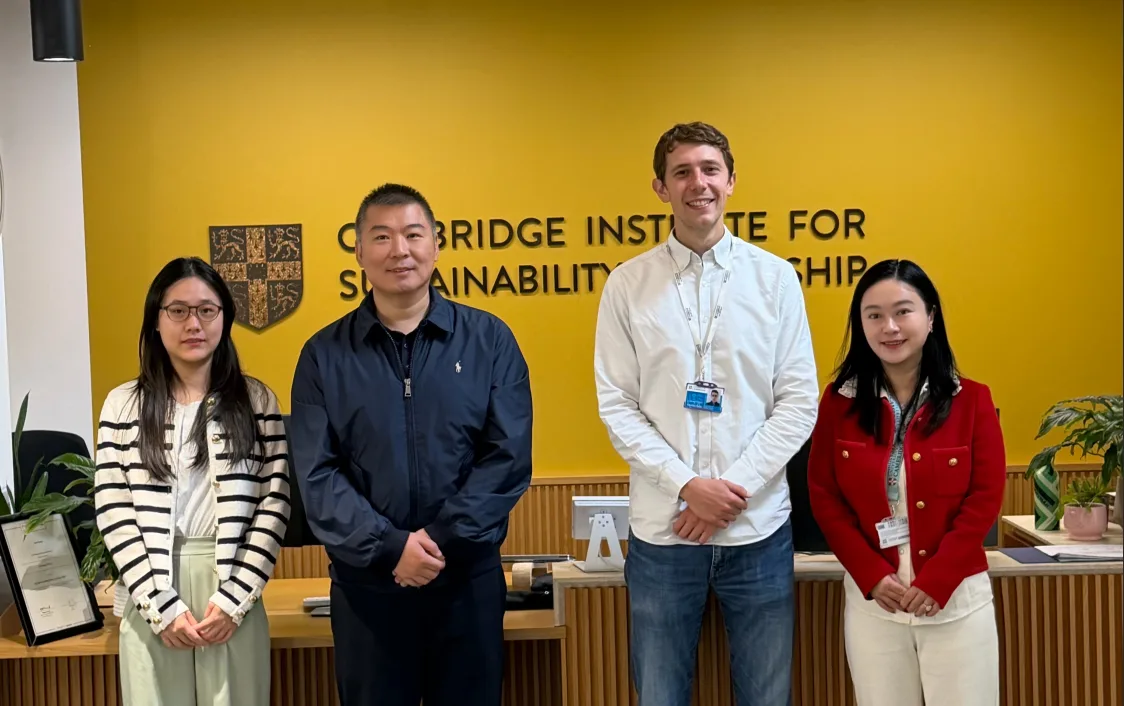
On October 15, Zhao Mengda, Executive Chairman of Shanghai Prospect Development Institute (hereinafter referred to as "SPDI"), Chairman of the China Culture Promotion Association Industrial Investment Association, and CEO of Longcharm Group, along with Dr. Wang Lina, Vice Chairperson and Executive Dean of SPDI and Co-founder of Longcharm Education, visited the Cambridge Institute for Sustainability Leadership (CISL). They held discussions with Anna Nitch-Smith, Executive Director and Chief Operating Officer of CISL, and Edmund Daley, Senior Client Relationship Manager. The meeting focused on sustainable development, leadership development, and regional talent capacity building, with the aim of exploring opportunities for cooperation in education and training.
During the talks, both sides introduced their respective focus areas, educational resources, and project experience, and expressed their willingness to further explore cooperation. SPDI shared its practices in talent cultivation, regional development services, and international educational exchange, expressing the hope to expand education and training programmes for the public sector, corporate managers, and professionals by aligning with the development needs and industrial characteristics of different regions in China and internationally, thereby promoting knowledge exchange and talent cooperation between China and international partners. CISL introduced its curriculum system that integrates Cambridge academic resources with industry practice, as well as learning formats such as online education, offline executive training, and customised programmes.
The two sides focused their discussions on three main areas. In terms of leadership development, they explored training opportunities on topics such as sustainable development strategies, and responsible AI application and governance. In terms of regional development, they discussed the possibility of carrying out customised talent training and cross-regional exchange cooperation for different regions in China and internationally, focusing on green industrial parks, energy transition, and local capacity building. In terms of industrial cooperation, they exchanged views on education and training needs related to sustainable innovation, finance, and international collaboration.
The two sides also exchanged views on matters such as blended online and offline training formats, language support, and curriculum adaptation. They explored combining thematic learning, case study discussions, and practical application according to the actual needs of different regions and learner groups, to help participants apply their learning outcomes to institutional management and business development.
Going forward, both sides will continue to communicate on key themes, course resources, and target trainee needs, refine pilot programmes, and promote the implementation of cooperation projects where conditions permit.