

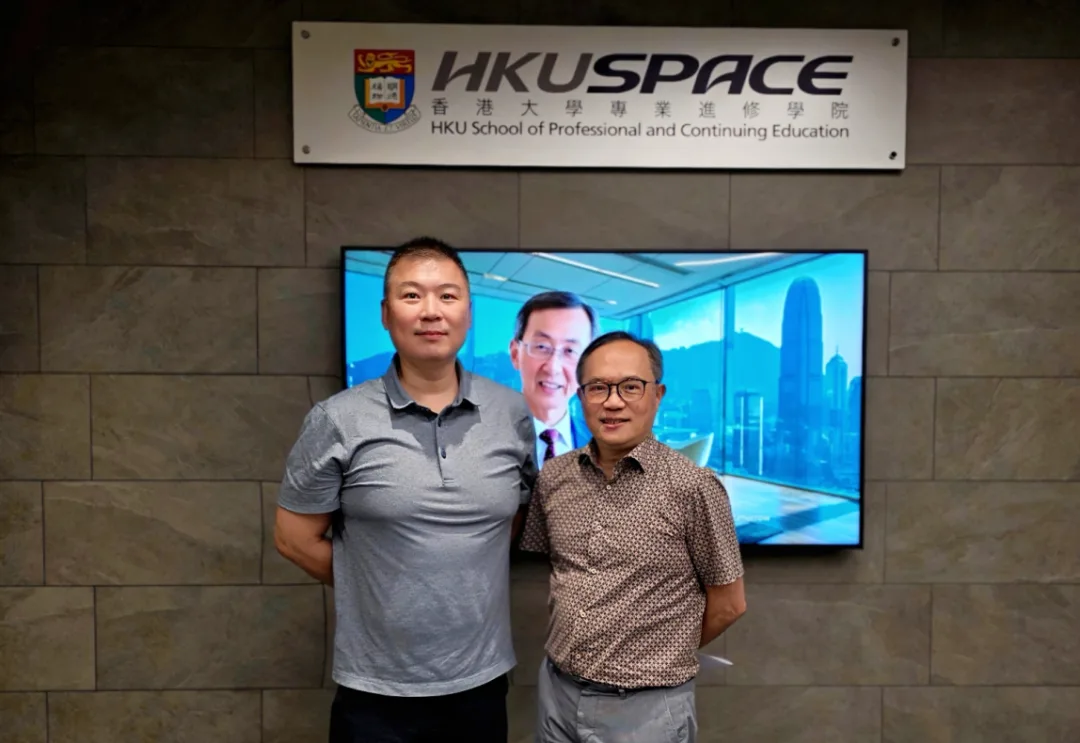
Shanghai Prospect Development Institute (hereinafter referred to as "SPDI") and HKU SPACE (The University of Hong Kong School of Professional and Continuing Education) recently held a cooperation meeting, reaching preliminary cooperation intentions on short-term programmes, youth winter and summer camps, AI courses, and adult and government training programmes. The meeting was attended by Zhao Mengda, Executive Chairman of SPDI and CEO of Lingcheng Group, and Dr. Wang Lina, Vice Chairman of SPDI and Co-founder of Lingcheng Education. The two parties had their initial contact in mid-June, with this meeting representing another round of in-depth discussions building on the foundation of earlier communications to further define the direction and model of cooperation.
HKU SPACE, established in 1957 as the first institution in the Asia-Pacific region dedicated to providing lifelong learning opportunities outside the formal university curriculum, officially adopted its current name in 1992. As a member of the University of Hong Kong, the School upholds the University's commitment to lifelong learning, offering continuing education opportunities that support both personal and professional development. HKU SPACE has maintained a partnership with the University of London for over six decades and has established strategic relationships with numerous renowned institutions worldwide. In recent years, HKU SPACE has actively pursued educational digital transformation, forging strategic partnerships with international technology companies including Google Cloud, and has accumulated extensive experience in AI curriculum development and pedagogical application.
SPDI traces its origins to the "Prospect Programme," jointly launched in 1993 by the China Youth Development Foundation and the China Association for International Exchange of Personnel, receiving its name inscription from a Chinese national leader in September of the same year. Over the past three decades, the Institute has trained more than 55,000 professionals, covering all 56 ethnic groups across 26 provinces and nearly 1,000 counties nationwide. With deep expertise in public administration, rural revitalisation, educational philanthropy, and international exchange, SPDI has built a strong foundation in government and enterprise talent development and in bridging resources between eastern and western China.
Both parties agreed that AI education represents the most promising priority area for collaboration. HKU SPACE has developed a mature AI curriculum system that can be flexibly adapted to different learner groups. For youth programmes, both parties plan to develop courses in "AI, Mathematics and Business Applications" to help students understand the fundamental logic behind AI and its application in real-world business scenarios. For working professionals and business managers aged 35 to 45, both parties will explore courses such as "AI for Business" and "AI & Career Transformation," addressing the pressing concerns of business owners and professionals regarding how AI will impact their industries and career development.
Both parties will follow the principle of "project-first, gradual expansion" in advancing their cooperation, with an initial pilot planned as a winter short-term programme scheduled for mid-to-late January 2027 through the Lunar New Year period, focusing first on AI-themed courses. The two parties explored a hybrid "online preparation + on-site learning in Hong Kong" model, where students complete online learning modules before travelling to Hong Kong for approximately one week of formal courses, group projects, and institutional visits—a model that balances programme completeness with cost control.
In the area of government training, HKU SPACE shared its experience in delivering large-scale AI application training for Hong Kong government administrators, having trained over a thousand participants across areas including document processing, data analysis, policy application, and integrated use of multiple AI tools. SPDI noted that this model aligns well with its existing government and institutional training resources. Future collaboration could explore multiple formats, including inviting participants to study in Hong Kong, having HKU SPACE faculty deliver training in the Chinese mainland, or developing online AI government training programmes. SPDI will expedite the confirmation of programme requirements and submission of institutional documentation to initiate HKU SPACE's internal approval process. Both parties plan to meet again in Hong Kong in late September to further finalise programme details and explore the production of promotional materials.
SPDI stated that Hong Kong serves as an international education hub, and this partnership with HKU SPACE represents a significant step in the Institute's strategy to deepen its international education presence and serve talent development. Looking ahead, SPDI will use this collaboration as a starting point to gradually expand into broader areas including adult education, government training, and online programmes, exploring multi-location hybrid education products that connect Hong Kong, Shanghai, and international partners, providing learners with more diverse and higher-quality international learning opportunities.